
From making wind power more predictable to uncovering the hidden career impacts of menstruation, 2 PhD candidates have been recognised for making complex and important research accessible to a wider audience.
Sathish Vijayaraghavalu Haridoss and Anjana Ajith received the runner-up and People’s Choice awards respectively in a Three Minute Thesis (3MT®) showcase, part of The University of Queensland (UQ)–Indian Institute of Technology Delhi (IITD) Research Academy Annual Symposium, at IIT Delhi, India.
In just 3 minutes, Sathish presented 'Stirring Up Trouble: Recipe for a Wind Ramp', exploring challenges associated with wind power, while Anjana presented 'Bloody Expensive: What Menstruation Costs Careers', examining the impact of menstruation in the workplace.
Sathish was named runner-up, while Anjana received the People’s Choice Award. IIT Delhi PhD candidate Manoj Kumar won the final for 'The Thermal Battery'.
Developed by UQ in 2008, 3MT® challenges research students to explain their work to a non-specialist audience in 180 seconds using a single static slide. At the Symposium, 12 shortlisted IITD and Academy PhD candidates took part in the competition before an audience of more than 200 researchers and students, with representatives from more than 30 industry and government organisations also participating.
Making wind power more predictable
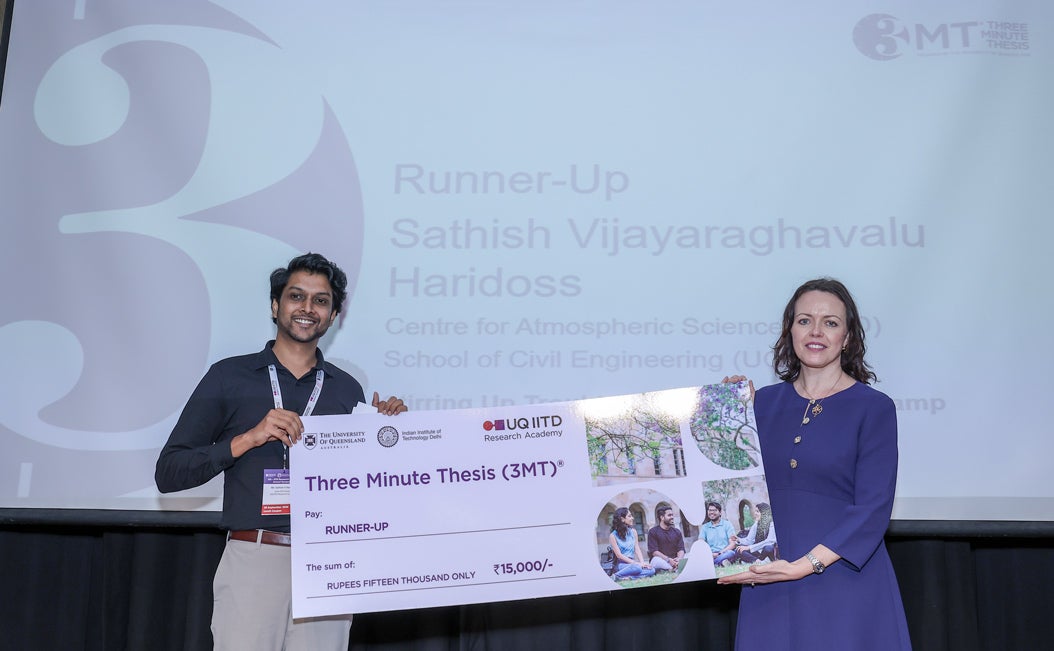
When wind power suddenly drops, electricity grids need to respond quickly to avoid supply shortages, price spikes and instability. Sathish’s research is helping uncover what causes these rapid changes, known as wind ramps, and how they might be better predicted.
“Cold fronts and troughs drive about 70% of extreme wind power ramps,” he said.
“Coastal wind farms see more ramps in winter, while inland farms are more prone in the warmer months, particularly when slow-moving, strong cold fronts pass overnight.”
The payoff is lead time. Being able to anticipate these weather systems could give wind farm and grid operators valuable time to prepare.
“Because these systems can often be forecast days ahead, my findings help wind-farm operators anticipate sudden changes and help grid operators schedule backup capacity,” he explains.
Sathish’s interest in wind energy grew from an early fascination with aerodynamics and the way fluids move. During his undergraduate studies, he became intrigued by the ways nature manages fluid flow, an interest he later explored through his master’s research on controlling airflow around wind turbines using ideas inspired by nature.
“What hooked me most was seeing the invisible mysteries of fluid flow. That sense of uncovering something unseen is what drew me to study wind farm flows for my PhD,” he said.
Sathish is now writing his thesis and expects to submit it before the end of 2026. He said drawing on complementary expertise in energy meteorology at IIT Delhi and wind engineering at UQ had shaped his research approach and findings.
“Working across Australia’s and India’s distinct energy systems and market operations has broadened my understanding of how weather-driven variability affects renewable integration, and has strengthened my ability to collaborate across disciplines,” he said.
Uncovering the hidden career costs of menstruation
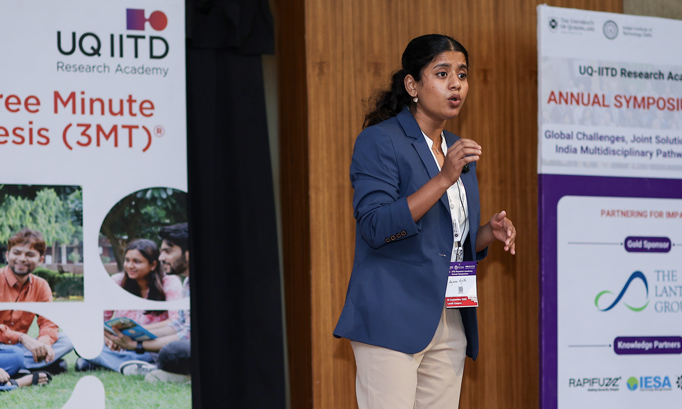
Anjana’s research examines an issue experienced by millions of workers but rarely discussed openly in the workplace: how menstrual stigma and inequity can affect careers.
Her 3MT® presentation struck a chord with the audience.
“Everybody in the room was either a menstruator themselves or had one or more menstruators in their life,” she said.
“I spoke about menstruators’ lives at work in terms of menstrual inequity, which would definitely resonate with all of them.”
A clinical psychologist as well as a researcher, Anjana was drawn to the topic by the polarised public debate on menstrual leave in the 2020s. When she looked for evidence to better understand the issue, she found a significant gap in the research.
“I wanted to read some empirical claims on the need, and when I felt a dearth of research, I thought of exploring it myself,” she said.
Her findings, still in the publication pipeline, point to the often-hidden effects of menstrual stigma in the workplace. Anjana found that marginalisation and economic constraints can affect career adaptability and work volition, potentially limiting people’s ability to access and sustain decent work. These impacts can be difficult to see because employees may avoid disclosing their needs or seeking support for fear of discrimination.
Anjana’s PhD compares the experiences of employees in India and Australia. While she initially expected to find marked differences between the two countries, her research identified a common challenge.
“We found that menstrual stigma is universal,” she said.
“A developed country like Australia, when compared to a developing country like India, did not have better or improved menstrual experiences.”
Her advice to employers is to create a ‘period-positive’ workplace by understanding menstruators’ needs, reducing stigma and providing appropriate support and accommodations.
The achievements of Sathish and Anjana come as the UQ–IITD Research Academy continues to grow its research community and impact. At its August 2026 convocation in India, 29 PhD candidates graduated, bringing the total number of Academy graduates to 52.
Applications are now open for the UQ–IITD Collaborative Grant Scheme 2026, supporting further joint research between UQ and IIT Delhi. Applications close Monday 16 November 2026. Enquiries can be directed to Ms Aashita Apoorva (uqiitd_par@admin.iitd.ac.in) and Dr Thao Dang (uqidarboard@uq.edu.au).
(Image credits: supplied by IIT Delhi.)


