
A Mexican genomic medicine researcher who studies how obesity accelerates biological ageing will travel to The University of Queensland (UQ) next year after winning Mexico's national Three Minute Thesis (3MT) competition.
Dr Xchelha Martínez Montiel, a clinical pathologist and researcher from Universidad Anáhuac México and the National Institute of Genomic Medicine (INMEGEN), explained years of complex research in just three minutes using a single slide.
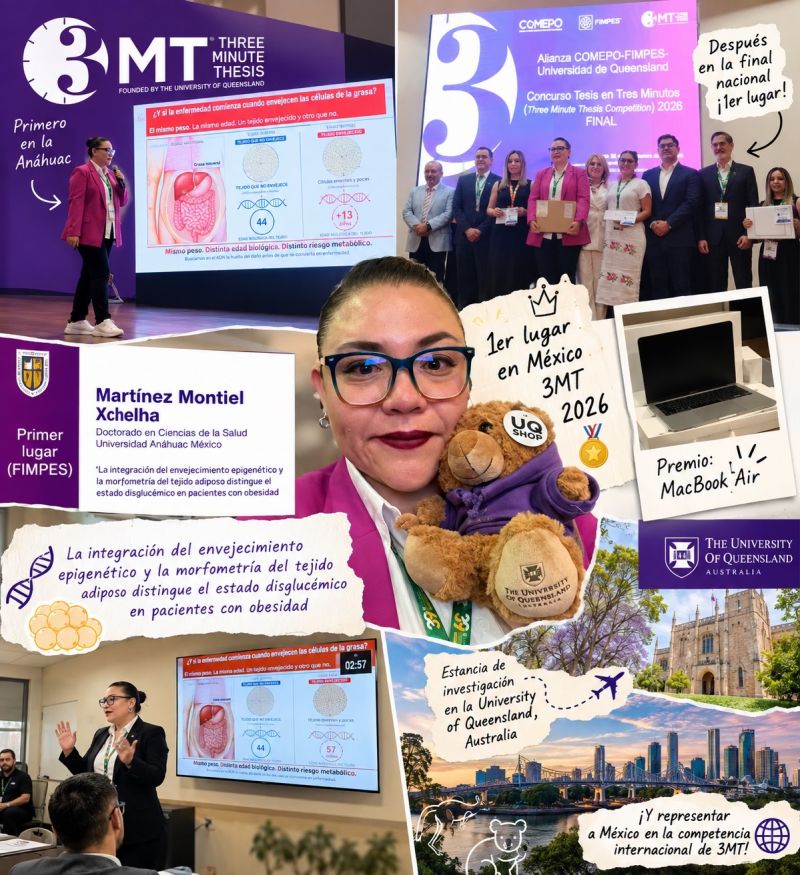
Her PhD research examines how human visceral fat ages at the molecular level. Using DNA methylation "epigenetic clocks", she investigates whether adipose tissue in people with severe obesity can be biologically older than the person who carries it, and how that ageing process relates to metabolic disease.
Faced with condensing years of scientific research into a presentation for a non-specialist audience, Dr Martínez Montiel centred her talk around a simple question: What if disease begins when your fat gets old?
Sharing news of her win on LinkedIn, she said she was "incredibly proud to have won 1st place at Mexico's National 3MT Competition and to represent Mexico, INMEGEN and Universidad Anáhuac México on the international stage".
"The hardest part was not cutting words. It was deciding what truly mattered," Dr Martínez Montiel said.
"The process forced me to think more deeply about my work and ultimately made me a better researcher, a better teacher and a better doctor."
For Dr Martínez Montiel, the achievement is a celebration of family and support. She rehearsed the presentation countless times with her husband and young son nearby and phoned home immediately after being announced the winner.
"One day, I'll tell my son that his Queensland teddy bear came from the other side of the world because his mother had three minutes to talk about science, and those three minutes took her to represent Mexico," she said.
The national competition was held during the 39th National Postgraduate Congress and Expo Posgrado in Tijuana and was jointly organised by the Federación de Instituciones Mexicanas Particulares de Educación Superior (FIMPES) and the Mexican Council for Postgraduate Studies (COMEPO).
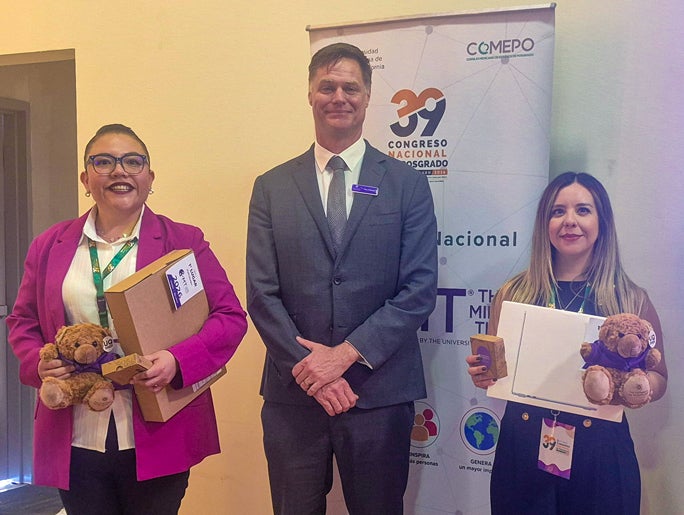
(Photo credit: Andrea Valencia, Senior Policy Manager (Education and Research), Australian Embassy in Mexico City.)
During the congress, UQ Global Partnerships Manager, Strategy and Partnerships (Americas and Pacific), Tom O'Brien presented Dr Martínez Montiel with a UQ Teddy Bear for her son and UQ gifts for her family.
Dr Martínez Montiel said she hopes her success encourages more Mexican researchers, particularly women in science, to share their research beyond the laboratory and engage broader audiences.
Fellow first-place winner Pamela Hernández Delgado from Universidad Autónoma de Chihuahua, representing COMEPO, will also visit UQ in 2027. Her presentation focused on thermoregulatory physiology in Chihuahua Criollo cattle.
Both winners will undertake short research visits to UQ in 2027, hosted by academics in their respective fields. Following their participation in the international 3MT competition in Los Angeles in December 2026, the visits will help them build international research networks and strengthen institutional links between Australia and Mexico.
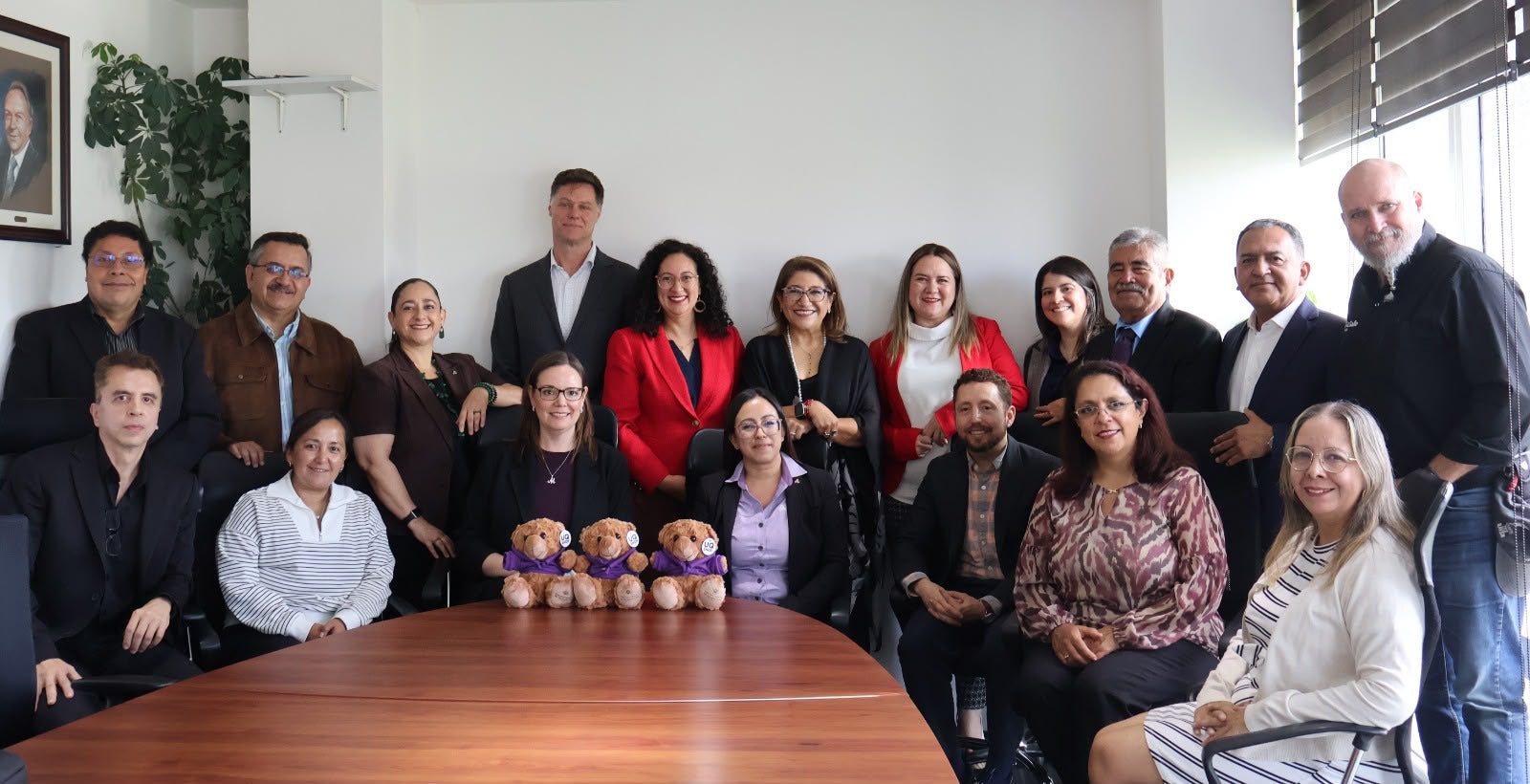
(Photo credit: Andrea Valencia, Australian Embassy in Mexico City.)
First UQ–FIMPES seed-funded research projects announced
The Tijuana congress also marked the announcement of the first three projects supported through the inaugural UQ–FIMPES Joint Research Seed Fund.
The scheme will provide US$10,000 to each project team, jointly funded by UQ and FIMPES, to establish early-stage research collaborations with the potential to generate joint publications, researcher mobility opportunities and future external funding.
The projects build on a 5-year agreement signed by UQ and FIMPES in June 2026 to strengthen research collaboration, mobility and knowledge exchange between Australia and Mexico. The initiative also coincides with the 60th anniversary of diplomatic relations between Australia and Mexico.
Rapid diagnostic technology for public health
Dr Elder De la Rosa Cruz from Universidad La Salle Bajío and Associate Professor Jody Peters from UQ's Australian Institute for Infectious Disease will develop a low-cost, paper-based rapid diagnostic test. The collaboration combines UQ's virus detection expertise with nanoparticle technology to explore faster and more sensitive testing for diseases including dengue and COVID-19.
More sustainable urban water utilities
Dr Hugo Briseño Ramírez from Universidad Panamericana and Professor Yongping Wei from UQ's School of the Environment will investigate how formal regulations and informal governance practices influence urban water utilities in Mexico and Australia.
The project aims to identify characteristics of high-performing utilities and produce a joint academic publication and policy brief.
"Through mutual and reflective learning, the water sectors in both countries can explore new approaches to adaptive governance in response to droughts, floods and climate change," Professor Wei said.
Industry 5.0 readiness in Mexican manufacturing
Dr Viridiana Flores Murrieta from Universidad Anáhuac Mayab and Professor Anthony Halog from UQ's School of the Environment will develop and pilot a bilingual assessment tool to measure Industry 5.0 readiness among Mexican small and medium-sized manufacturers.
The tool will assess circular economy practices, digital capability, resource efficiency, workplace conditions and organisational resilience, helping businesses prepare for more sustainable and human-centred industrial models.
For more information, contact:
Tom O'Brien
Global Partnerships Manager, Strategy and Partnerships (Americas and Pacific)
The University of Queensland
tomas.obrien@uq.edu.au


